Showing posts with label Old Testament. Show all posts

Saturday, June 14, 2014

Exodus 14: Moses Parts the Red Sea

Scripture summary is in black
My comments and questions are in purple and numbered
Christian commentaries and my responses to those are in blue. Unless otherwise stated, these are from Guzik's commentary
(Note: I've changed my format a bit with this post, let me know if you like/dislike the changes)

Today's Podcast

Previously:

The Israelites are enslaved by the Egyptians, so God tells Moses to go rescue them. Moses proves to Pharaoh that God is on his side, but God hardens his heart so he won't let the people free. Then God sends plague after plague upon the Egyptians so Pharaoh finally lets the Israelites go.

Crossing the Red Sea (v. 1-31)

God tells the Israelites to go to a particular spot and set up camp where they will be trapped by the sea. Then God will harden Pharaoh's heart to make him pursue the Israelites. Then God will "get glory over Pharaoh" and the Egyptians will know he is the lord. The king of Egypt was told that the Israelites had fled and his mind and the mind of his people was changed toward the people. They pursued the people of Israel as they had gone out defiantly.

1. Free Will: Once again, God has taken away Pharaoh's free will. He didn't simply make Pharaoh aware of the Israelite's apparent poor tactical position, he hardened his heart. 
Even after the horror of the death of the firstborn, the change in Pharaoh's heart was only temporary. He was quick to strike at Israel when he had the chance.
Wow, if Pharaoh was so quick to strike whenever he had the chance, then why did God have to harden his heart?

2. God's Motivation: The reason that God has done this is to "get glory over Pharaoh" and so "the Egyptians shall know that I am the LORD". It really does appear that God is doing this just for his own ego, how does him getting glory help his people?


3. Do the Egyptians Know God is Powerful? God does this in part so that the Egyptians will know that God is the LORD. Why is this necessary? God just plagued the shit out of Egypt to convey this message. And the message was apparently received earlier when the people of Egypt insisted that the Israelites leave, have they forgotten the plagues already? It just doesn't make sense. 

i. This demonstrates how we are often quick to forget what God has done and what He has shown us. It is easy to quickly move from walking in the spirit to walking in the flesh. 
ii. Perhaps Pharaoh thought that the LORD had shot all His arrows and had no more "ammunition" against Egypt. After all, no more died after the plague of the firstborn; but God isn't short on resources. He had plenty of ammunition left.
ii doesn't make much sense to me, if Pharaoh thought that then he wouldn't have let them leave in the first place, right? i though, is exactly the kind of thing I remember hearing from church all the time. Seems like a good way to relate the story to our lives "don't be forgetful, don't fall into your old ways" etc. Seems good for that purpose I suppose, still though, for the story itself it doesn't make a lot of sense. Are you really going to forget so fast with so much death and destruction around you? 

4. Pharaoh and the King of Egypt: I was actually a bit confused on whether Pharaoh and the king are the same person. Verse 8 seems to suggest they are the same person. However, in verse 5 seems to suggest that the king is surprised that they Israelites have been set free even though in chapter 12 Pharaoh was the one who let them go in the first place. It's possibly a minor point, but the story doesn't really make sense if they are the same person. I wonder if this is a case of two different stories being merged into one. This would also explain why he has two different titles for no apparent reason.

5. Defiance: Verse 8 says that the people of Israel "were going out defiantly", but that makes no sense as they were told to leave Egypt. In fact, they were pushed out of Egypt so fast they weren't able to finish their bread, which is supposedly the origin of the unleavened bread at passover. Am I missing something here?

6. My Previous Christian Perspective: I often like to think about how I would justify things back when I was a Christian. I'm pretty sure that in this case I would have said that the Egyptians would chase the Israelites at some point in time no matter what God does. Therefore God is only manipulating the timetable of things rather than actually changing Pharaoh's ultimate actions. I'm fairly certain this would have satisfied me back then, but the problem is it is not supported by the text at all. If that's what God was doing why not say it? Instead he says he's doing it to get glory. I suppose it doesn't contradict the text, but if that was really the reason it seems like it should have been stated.When the Egyptians got near to the cornered Israelites they were very afraid and complained to Moses. They even said that they would rather have stayed in Egypt as slaves than to be killed out here. Moses said that God would fight for them and save them out here.


7. Should they be afraid? I've seen atheists complain about the reactions of the Israelite slaves in the past. "They have an all powerful God helping them, why would they be afraid?". And while that might play in a bit here, I can totally understand them being afraid anyway. Imagine yourself in the same situation, even if there is a really powerful being who can save you, are you sure he will? Hell, even if you were convinced that he was going to save you, it would still be scary seeing that army close in on you.

God complains that the people are crying to him. He tells the people to walk forward and for Moses to lift his staff in order to divide the sea so the Israelites can walk on dry ground there. God will then harden the hearts of the Egyptians to ensure that they will follow, then they will know that god is the LORD once he "gets glory" over them.

8. God's Attitude: I don't really understand why God is complaining about these people. He's put them in a very scary position with no apparent way out and they are asking him for help. He seems to be put off by it, like they should have known that Moses could part the sea for them. It kind of reminds me of the stereotypical douchebag IT guy from the 90s.
The children of Israel cried out to the LORD: This was a good thing to do. When we find ourselves in dangerous places with no easy escape, we must cry out to God, because God is our refuge and strength, a very present help in trouble (Psalm 46:1)
This I find interesting, he says that crying out to God was a good thing, and yet it seems to me that God is saying they shouldn't have done it. In verse 15 God says "Why do you cry out to me?" I was thinking perhaps I was reading too much into it, but then Guzik says
Their fear could be understood and their cry to the LORD made sense. Yet their words to Moses show a great lack of faith and loss of confidence in God.
So it's good to cry out to God, but you shouldn't need to if you have faith? I dunno, seems a bit mixed up to me. And one final comment along these lines
The children of Israel were not yet a week out of Egypt and they were already distorting the past, thinking that it was better for them in Egypt than it really was.
This just made me laugh. Yes, they were slaves in Egypt and the conditions were terrible. But they are comparing it to the fact that they think they're about to die. 

9. Free Will Again: Seriously, is there any part of this plan where God isn't manipulating the Egyptians to do what he needs them to do?

parting the red sea
parting the red sea (Photo credit: amboo who?)
The pillar of cloud moved to be between the Israelites and the Egyptians and the two groups stays separated throughout the night. Moses raised his staff and there was a strong east wind all night that made the sea part like walls so the men could walk on dry land. The Israelites went onto the path and the Egyptians followed. In the morning God looked down from the pillar of cloud and fire and threw the Egyptians into a panic by clogging the chariot wheels so they would be slow. God had Moses hold his staff toward the Egyptians and the water rushed over them, yet the Israelites still were able to walk on dry land, having walls of water on both sides of them.  The Israelites saw the Egyptians dead on the seashore, so they feared the LORD because of the great power he used against the Egyptians, and they believed Moses.

10. How Long Did This Take? It's funny, my mental picture of this story has the water turning into walls pretty much instantaneously, yet in the actual story it takes all night. I suppose it's from a smattering of popular culture references that my impression is wrong here.

11. Omniscience? I find it interesting that God was looking down from the pillar of cloud and fire. This appears to be describing a powerful being in a specific physical place rather than an omniscient God.


12. Fear: I find the very concept of being "god fearing" and odd, it certainly seems to fly in the face of an omnibenevolent God


13. Violence: Once again, we see extreme violence from God, he kills tons of Egyptians apparently to prove a point to his people.
An oppressed people are slow to believe they are free while their tyrant still lives. God wanted Israel to know that their oppressors were dead
I guess that is a decent explanation as to why God would go to these extremes. Really seems like a fucked up route to go though.

Verses of Note:

--Fear--

Exodus 14:31 The Israelites fear God, which seems to largely be the point of this story

"Israel saw the great power that the LORD used against the Egyptians, so the people feared the LORD, and they believed in the LORD and in his servant Moses."

--Free Will--

Exodus 14:4,8,17 God takes away Pharaoh's free will again

"And I will harden Pharaoh's heart, and he will pursue them, and I will get glory over Pharaoh and all his host, and the Egyptians shall know that I am the LORD." And they did so."

"And the LORD hardened the heart of Pharaoh king of Egypt, and he pursued the people of Israel while the people of Israel were going out defiantly."

"And I will harden the hearts of the Egyptians so that they shall go in after them..."

--God's Ego--

Exodus 14:4,18 God's motivation seems to be stroking his ego

"And I will harden Pharaoh's heart, and he will pursue them, and I will get glory over Pharaoh and all his host, and the Egyptians shall know that I am the LORD." And they did so."

"And the Egyptians shall know that I am the LORD, when I have gotten glory over Pharaoh, his chariots, and his horsemen."

--Violence--

Exodus 14:27-30 God killed all of the Egyptians in this story (through Moses)

"the sea returned to its normal course when the morning appeared. And as the Egyptians fled into it, the LORD threw the Egyptians into the midst of the sea....and Israel saw the Egyptians dead on the seashore"

Saturday, March 8, 2014

Exodus 13: A Pillar of Fire? Cool!

today's podcast

Previously:

After a swath of plagues from God, the Egyptians finally kicked the Israelites out of Egypt.

Consecration of the Firstborn (v. 1-2)

God says to consecrate the first born (among men and beasts) to him.

I'll be honest, I didn't know what the hell "consecrate" means. I had to look it up. Apparently it is just declaring something sacred. So in this case we are saying the firstborn is the most sacred and they belong to God, or they are to be used for a holy purpose...or something like that I guess. We saw this before with Esau and Jacob, it appears that the social convention was that the older one was preferred, but in Genesis 25 God demonstrated a willingness to go against the convention and favor the younger at times. That appears to be over now, God wants to consecrate the firstborn which seems to say that the preference to the younger won't happen again. (BTW, if anyone thinks I'm way off base here let me know, I am sorta shooting from the hip on this one).

From Guzik:
Consecrate to Me: The idea is that the firstborn was to be set apart to God, whether of man or beast - the firstborn belonged to God.
I still don't really understand what that means. So the firstborn son "belongs to God", does that mean he has work for the church? or serve the spiritual leaders? Or what? Perhaps this is obvious and I'm just being thick, but I really don't understand what is being said here. 

Also, I don't understand the preferential treatment for the firstborn at all. Sure, it is understandable that the first kid would be seen differently from any subsequent children (especially if the first kid was a medical marvel), the first is always going to be different and I could imagine the average parent would treat them a bit differently. But why cement that with a declaration from God? Shouldn't the ideal be to treat all of your children equally? To put everyone on equal footing? I assume the answer to that will typically be that it was a different time back then, but if that is the answer then why is it a good idea to use this book as a guide for how to live our lives in the modern world?

The Feast of the Unleavened Bread (v. 3-16)

They get instructions about not eating leaven for a week every year.

Didn't we just cover that material last chapter?

All of the firstborn will be for God, all firstborn male animals will be sacrificed to God and all firstborn male children must be redeemed.

I'm not 100% sure what it means to say the firstborn sons must be redeemed, but verse 13 says that firstborn donkeys either need to be redeemed with a lamb or have their necks broken. Presumably the redemption of the donkey is sacrificing the lamb. So my guess is when it comes to firstborn children being redeemed, there is also a sacrifice of an animal involved.

From Guzik:
But every firstborn of a donkey you shall redeem with a lamb … And all the firstborn of man among your sons you shall redeem: If the firstborn was unacceptable to sacrifice (an unclean animal or a human) a substitute was offered to redeem the firstborn from God. If the firstborn was an animal the substitute was a clean animal. If the firstborn was a human, the substitute was money.
So you are supposed to sacrifice the donkey, but you can use a lamb instead. You are supposed to sacrifice the first child, but you can pay money instead? I still find myself confused. What exactly are they being redeemed from? Why does only the firstborn need redemption? Who gets the money?

Pillars of Cloud and Fire (v. 17-22)

When the people left Egypt, God didn't send them via the most direct route (through the land of the Philistines) because they might see war and return to Egypt.

Wait, what!?! They were slaves in Egypt, they would return to that voluntarily because they see war? Do they have to fight in this war if they pass through this land? I looked through other translations, and some indicate that they would have to fight to get through the land. Even still, fighting to get through a country would be different than actually taking a direct part in the war right? Especially with 600,000 men, you would think they can pass through without getting too terrible involved with the fighting.

But that's irrelevant anyway, they were cast out of Egypt so fast they had to take their bread without finishing it, and they didn't have other provisions ready. They wouldn't be allowed to return if they wanted to. It just doesn't make sense.

From Guzik:
It would have been easy for the Israelites to think that the Via Maris was the way to go; it had good, easy roads, the shortest distance, it was a trade route so food and water could be bought. But the dangers of the way were too great, even though they could not see them. The same is true of our walk with God; a way that seems right to us may turn out to be full of danger we can't even think of.
This is an interesting way to use this passage as a connection to our lives I suppose. I remember hearing this kind of thing in church all the time. It still doesn't solve the problem of the inherent ridiculousness of the passage itself. Even Guzik points out that if they go that way the people would see war and might return to Egypt. That makes no sense. 

God instead led them through wilderness toward the red sea equipped for battle.

They are avoiding the war, why are they equipped for battle? I feel like I'm missing something substantial here.

Moses brought the bones of Joseph along as was promised back when Joseph died.

I didn't remember this, but as we can see it did happen in Genesis 50, I didn't make a note of it at the time, apparently I missed this strange detail.
English: Lag BaOmer bonfire
(Photo credit: Wikipedia)

God led the way in the form of a pillar of cloud during the day and a pillar of fire at night so they could travel day and night.

That's kinda cool I guess. 

One final thing from Guzik:
He did not take away the pillar of cloud by day or the pillar of fire by night from before the people: We often think that such miraculous assurance would make us never doubt the LORD again, but Israel certainly did - and so would we
This also reminds me of things I would hear in church all the time. They like to make these bold declarations about what everyone would do in the same situation. The huge number of people around today who don't doubt God with nowhere near this kind of evidence would seem to blow a hole in this idea. This kind of thing drives me crazy, and seems to me that it is just an attempt to explain away the illogical reaction that the Israelites will have later on. 

Moral of the Story:
Trust in God, he can see dangers that we can't.
This is right from Guzik's commentary up above, furthermore, it is something I remember hearing in church and that I hear from Christians all the time. Trusting in God and letting him guide your life is a pretty common thread in a lot of Christianity as far as I can see. And honestly, it seems like it works pretty well for a lot of people, the question is how it works. 

If you ask them, they would probably say that they pray and God tells them what they should do. In my opinion, they hear messages in church that generally focus on being a good person, helping their fellow man and such. They know what being a good person generally entails, and they apply those qualities to their God. Then when they do something that doesn't live up to that ideal, they think of it as God being disappointed in them or something, and use that as motivation to stop doing the bad thing. Not too different from what an atheist does, except we would just say it is our conscience or something.


Verses of Note:

--Short Memory--

Exodus 13:17 They might return to Egypt? Really?

"When Pharaoh let the people go, God did not lead them by way of the land of the Philistines, although that was near. For God said, "Lest the people change their minds when they see war and return to Egypt."
Enhanced by Zemanta

Monday, January 20, 2014

Exodus 12: God Slaughters the Firstborn in Egypt

Today's podcast

Previously:

God has sent a bunch of plagues to Egypt to try to get the Pharaoh to let his people go. Last chapter he warned of the final plague, the death of all the firstborn in Egypt.

The Passover (v. 1-28)

God declared the current month to be the beginning of the year. Then he said that on the tenth day of the month, every house (or if a house is small they can combine with a neighbor) shall take a year old male lamb without blemish. Wait until the 14th of the month and everyone will kill their lamb at twilight.

The specificity of the request for the sacrifice caught my attention. In fact, the whole idea of God wanting sacrifice seems odd. Perhaps that's just because we don't do sacrifices any more, but it just seems so strange.

From Guzik:
In this way, the lamb became part of the family. By the time it was sacrificed on the fourteenth it was cherished and mourned; God wanted the sacrifice of something precious.
I suppose some people would become fond of their lamb, but how attached are you really going to get to an animal that you know is being sacrificed in four days?

Take some of the blood from the sacrifice and put it on your door. Eat the meat with unleavened bread and bitter herbs. Roast the meat, don't boil it or eat it raw, if any meat is uneaten burn it.

Again, the specificity seems strange to me.

From Guzik:
Structural lintel
Structural lintel (Photo credit: Wikipedia)
As the blood was applied to the top and each side of the doorway, this blood dripped down, forming a figure of a cross in the doorway.
Wait what? How could it form a cross? Perhaps I'm picturing this wrong. So I went back and looked at verse 7 which says
take some of the blood and put it on the two doorposts and the lintel of the houses
I had to look up what a lintel is, but it is basically just the top of the door. Put blood on that and the doorposts and you get an arch, not a cross. It's amazing to me how desperate some Christians are to insert Jesus into the old testament.


google image search for passover blood
I then did a google image search for "passover blood". Most are what I was expecting, but one picture near the bottom right looks like a cross. Are they supposed to put the blood on the door as well? I had to go back and reread the text.
7 "Then they shall take some of the blood and put it on the two doorposts and the lintel of the houses in which they eat it
Doesn't say anything about the door. I suppose they aren't forbidden from putting it on the door, so if they do you get a cross. But it definitely isn't inevitable as the rest of the images reveal.

And more from Guzik:
As our Passover sacrifice, Jesus had to come into direct contact with the "fire" of the Father's judgment on our behalf, and the bitterness of the cross is reflected in the bitter herbs.
Wow, again, inserting Jesus into the old testament. A few quick google searches found better answers. This site explains that the fire is symbol of what was happening with the exodus. If you cook with fire you separate ingredients, if you boil the meat will take on aspects of the water (such as spices I suppose). This site explains that he bitterness reminds us of the bitterness of the slavery the Israelites are escaping from. Honestly, I find the explanation from Guzik completely ridiculous, and I imagine a Jew would find it downright offensive. In fact, I showed this to my wife (who is Jewish) and she made a pretty funny "what the fuck!" face.

One more thing from Guzik here:
For the first Passover, the unleavened bread was a practical necessity - they left Egypt in such a hurry there was no time to allow for the dough to rise.
That just makes no sense (although I looked around at other sites and it seems to be the common explanation). For one thing, they were told ahead of time to eat unleavened bread. It's not like they were cooking it normally and they had to leave unexpectedly or something. If timing was the issue they could have just started making it earlier.
Leaven was also a picture of sin and corruption, because of the way a little leaven influences a whole lump of dough, and also because of the way leaven "puffs up" the lump - even as pride and sin makes us "puffed up."
That, on the other hand, is actually some decent symbolism. I could believe that this is really the reason for the unleavened bread.

God will pass through the land of Egypt and kill all of the firstborn, except the blood will be a sign for him to skip your house.

Why exactly does God need the blood on the doors to know which houses to skip? It's almost like he's not all knowing. I suppose an answer I would have given to this when I was a Christian is that God knew who was going to put the blood on their door ahead of time, and so he is still all knowing, but there is value in having them actually do it. It's not too dissimilar from God calling out to Adam and Eve to find out where they are in the garden after they ate the fruit. It seems much more likely to me that the God written about here wasn't supposed to be all knowing, but I also know that this explanation would have satisfied me as a Christian.

English: A depiction of the Matza. עברית: תיאו...
English: A depiction of the Matza.
 עברית: תיאור של מצה.
 (Photo credit: Wikipedia)
Keep this day as a memorial throughout generations. For 7 days don't eat leavened bread, remove it from your house on the first day, for if anyone eats leavened bread during that time, they will be cut off from Israel.

God damn that is harsh. 

Have a holy assembly on the first and seventh days, no work shall be done on those days except to prepare food, but only what people need to eat.

No leftovers?

Then they repeat the instructions 3 times. Wow, God really doesn't want people to eat leaven, got it.

Then Moses calls over the elders and repeats the instructions again. Why the repetition?

The Tenth Plague: Death of the Firstborn (v. 29-32)

As promised, God kills all of the firstborn. From the Pharaoh to the prisoners, every house has someone dead. Even the livestock have their firstborn killed.

I really don't understand why there needs to be so much death. It works in the story, but is there really no other way? I suggested in the last chapter that as a Christian I would have probably accepted a "no half measures" narrative to explain this. But damn, it's hard to believe an all powerful God can't find a better solution.

Interesting note from Guzik:
This plague was directed against two significant Egyptian gods. First, Osiris was the Egyptian god thought to be the giver of life. Second, against the supposed deity of Pharaoh himself, because his own household was touched
As before, it seems that this is really a pissing match between various gods.
An inscription was found in a shrine connected with the great Sphinx that records a solemn promise from the Egyptian gods vowing that Thutmose IV would succeed his father Amenhotep II - whom many believe to be the pharaoh of the Exodus. Why did they make such a unique, emphatic promise from the gods that something so natural would happen - the eldest son take his father's place as Pharaoh? Undoubtedly, because Thutmose IV was not his father's firstborn son, and the firstborn was struck dead at the first Passover. Therefore, they believed that the second born son needed special protection from the gods and the inscription seeks to provide that.
I'm no historian and have no idea how to verify any of these claims, but it is interesting nonetheless. 
In dealing with Pharaoh, God first had to inform his mind, and then break his will. Pharaoh's problem wasn't that there was insufficient intellectual evidence; his heart had to be broken and made soft towards God.
Wait, he needed to have his heart made soft toward God? Why did he harden it first then? Is the argument that it had to be hardened first in order to break it? Like, it was breaking a little bit, so God hardened it so that he could really break it? I suppose there is some logic to that, but damn.

Pharaoh calls Moses and Aaron in the middle of the night and tells them to gather up all of their people, and their flocks and herds, and be gone to serve God.

Way back at the beginning of all of this, Moses and Aaron weren't asking for the slaves to be free, just to be able to go out into the wilderness to worship God. It's not entirely clear to me whether Pharaoh is telling them to go forever, and be free, or just telling them to go worship God and then come back.

Pharaoh also asks Moses and Aaron for a blessing.

This seems beyond strange to me. He's asking for a blessing from the person whose God has just decimated his country. Is this perhaps a way of asking if God will knock it off now that he's finally releasing the Israelites?

The Exodus (v. 33-42)

The people of Egypt wanted the Israelites to leave urgently, so they had to leave before their dough was leavened.

Moses had told the Israelites to ask the Egyptians for silver and gold, and God gave them favor so the Egyptians would comply. "Thus they plundered the Egyptians".

Whoa! They plundered them? When this was brought up before I wondered what favor meant and I accepted the idea that they were receiving payment for centuries of slavery, and that they were probably taking money from wealthy people who had profited off of their labor. That still might be true, but I don't like the idea of them plundering. I thought it might be worth it to look at some alternate translations, I see "they robbed the Egyptians", "they took away all their goods from the Egyptians", "they stripped the Egyptians". Seems excessive. I suppose the question remains of who they are taking this money from, if it is the people who directly benefited from their enslavement maybe it's okay. If it is just random Egyptians (which this verse seems to imply to me) then it doesn't seem like justice at all.

600,000 men (plus women and children) journeyed from Rameses to Succoth with their livestock. They baked unleavened cakes, because they were rushed out of Egypt with unfinished dough and they hadn't prepared provisions.

I hadn't really thought about this before, but the whole point of the final plague was to do just this right? To make the Egyptians want the Israelites the hell out of their country. Why didn't god just tell his people to be ready to go. "Hey guys, in addition to putting blood on your doors so that I don't kill your firstborn, have your bags packed". [Later addition: Actually, a second reading reveals that he did: v.11 "In this manner you shall eat it: with your belt fastened, your sandals on your feet, and your staff in your hand. And you shall eat it in haste." Shouldn't this include having provisions packed for the journey?]

The text says that the 600,000 men were "a mixed multitude". I didn't know what that meant, but Guzik has some insight:
Not all of the 600,000 were Israelites. Many Egyptians (and perhaps other foreigners) went with them, because the God of Israel demonstrated that He was more powerful that the gods of the Egyptians.

Institution of the Passover (v. 43-51)

Here God sets the rules for the Passover celebration in the future.


No foreigner shall eat of it but your slaves, which have been purchased, can join in if you have circumcised them. However, no hired servants may eat of it.

This is interesting! There is a distinction between slaves that you have purchased and just hired servants. Doesn't this break the defense that slavery in the Old Testament is just indentured servitude? Those people would seem to qualify as hired servants, right?

If a stranger stays with you they can participate if they will agree to a circumcision. Such a stranger is subject to the same laws as you.

I guess the point is supposed to be that by getting circumcised, you are joining the tribe? Were there no other groups at this period in history that practiced circumcision?

In my summary I skipped the rule that the bones of the lamb can't be broken, but Guzik forced me to bring it up with this comment
None of the bones of the Passover lamb were to be broken. This looks forward to Jesus, the ultimate Passover Lamb, who had not one bone broken even in His crucifixion (Psalm 22:17, John 19:31-36).
This sounds pretty crazy to me, and it sounds like they are just trying to cram Jesus into the Old Testament again. I was curious what the real symbolism of the lamb not being allowed to have his bones broken, but all I could find was this same interpretation. I figured the best place to look would be on Jewish sites, but they all just explain that you can't break the bone at the passover seder and point to the verse, I couldn't find an explanation as to the symbolism here. If anyone knows the symbolism or has better googling skills than me, please enlighten me.

Moral of the Story: It's really just the same moral as the last few chapters, follow God's commands or else.

Verses of Note:

--Justice--

Exodus 12:15 Excessive punishment for trivial crimes

"if anyone eats what is leavened, from the first day until the seventh day, that person shall be cut off from Israel"

--Properties of God--

Exodus 12:23 Why does an all knowing God need blood on the doors to know which houses to skip

"For the LORD will pass through to strike the Egyptians, and when he sees the blood on the lintel and on the two doorposts, the LORD will pass over the door and will not allow the destroyer to enter your houses to strike you"

--Slavery--

Exodus 12:44-45 A distinction is made between slaves and servants

"but every slave that is bought for money may eat of it after you have circumcised him. 45 No foreigner or hired servant may eat of it."

--Stealing--

Exodus 12:36 With god's help, the Israelites stole from the Egyptians before they left town

"And the LORD had given the people favor in the sight of the Egyptians, so that they let them have what they asked. Thus they plundered the Egyptians."

--Violence--

Exodus 12:12 God says he will kill all of the firstborn in Egypt

"For I will pass through the land of Egypt that night, and I will strike all the firstborn in the land of Egypt, both man and beast; and on all the gods of Egypt I will execute judgments: I am the LORD."

Exodus 12:29 God follows through on his threat to kill all of the firstborn in Egypt

"At midnight the LORD struck down all the firstborn in the land of Egypt, from the firstborn of Pharaoh who sat on his throne to the firstborn of the captive who was in the dungeon, and all the firstborn of the livestock."
Enhanced by Zemanta

Sunday, December 8, 2013

Exodus 11: This Plan Seems Excessive

Today's Episode

Previously:

God has dropped 9 plagues so far on Egypt in an attempt to get Pharaoh to let his people go and show off his power.

A Final Plague Threatened (v. 1-10)

God says he has one more plague to bring to Egypt, after which they will be let go, and driven away completely.

It occurs to me that when I was a Christian, this whole story would have been justified with a "no half measures" narrative. In the past, Pharaoh went back on his word and tried to set terms for their release. You don't send a message with a half measure, God needed to hit the Egyptians hard to make sure the conflict would be over, the Israelites would be driven out completely and without conditions.


picture from fight club
How would I respond to such an argument? I suppose I would argue that an omnipotent God of love should be able to come up with a more elegant solution. But ultimately, it is hard to argue, as you can always say that any other action would not have been effective, that anything less would have not worked as well and had repercussions later on. I find it hard to believe that such death and destruction would really be the best of all possible solutions, but there really is no way to solidly argue that as far as I can see.

The Israelite people are then told to ask their neighbors for silver and gold jewelry. "The Lord gave the people favor in the sight of the Egyptians."

What does that mean exactly? God gave them favor? It doesn't sound like he's forcing them exactly, but he's got to be doing something to get these people to give their valuables to some former slaves. Is the argument supposed to be that it is fair payment for years of slave labor? I suppose there is an argument to be made there, if freed slaves from the south took gold from plantation owners I wouldn't have a problem with it. Is that the kind of thing we're talking about? 

From Guzik
This was how the slaves of Israel received their "back wages" from their time of slavery, and how they did not leave Egypt empty-handed.
So yeah, he's saying that this is their payment for generations as slaves. It is not clear who exactly they are getting these valuables from, but I see no reason not to assume it would be people who have benefited from their work over the years. The more I think about this the more I'm okay with it. 

Moses tells Pharaoh that God will kill every firstborn in Egypt at around midnight, from the firstborn of Pharaoh to the firstborn of the cattle. But none of the Israelites will be harmed. Pharaoh's people will then bow down to God and beg for the Israelites and God to leave Egypt.

First of all, last chapter Pharaoh said that if Moses talked to him again he would be killed and Moses responded that Pharaoh would never see his face again. Now in the very next chapter they are talking again.

Anyway, seems like a lot of murdering to do for an all-loving God. Really, it seems like the only explanation I can come up is the "no half measures" mentioned above. It's just hard to imagine this is the only way to free his people.

Then God tells Moses that Pharaoh will not listen to him "that my wonders may be multiplied in the land of Egypt"

Not that we really need more evidence, it was pretty explicit in the last chapter that God was manipulating Pharaoh. But here is more evidence that God was messing with his free will. God says that Pharaoh won't listen to Moses and the purpose is that God can show off. If that is the purpose, I think it is a pretty hard sell that it was not God himself forcing Pharaoh to act that way.

Guzik affirms here that God is taking away Pharaoh's free will
If nine plagues had come from the hand of God, one might expect that the warning about a tenth plague would be believed; but Pharaoh's heart remains hard, and God strengthens Pharaoh in his hardness of heart.
Of course I'm sure he would say that he's helping Pharaoh fulfill his own desires or some such nonsense. Same argument we saw before.

Verses of note:

--Free Will--

Exodus 11:9-10 Once again, God points out that he manipulated Pharaoh's free will

"Then the LORD said to Moses, "Pharaoh will not listen to you, that my wonders may be multiplied in the land of Egypt. Moses and Aaron did all these wonders before Pharaoh, and the LORDhardened Pharaoh's heart, and he did not let the people of Israel go out of his land."

--Violence--

Exodus 11:4-5 God will kill all firstborn in Egypt

"So Moses said, "Thus says the LORD: About midnight I will go out in the midst of Egypt, and every firstborn in the land of Egypt shall die, from the firstborn of Pharaoh who sits on his throne, even to the firstborn of the slave girl who is behind the handmill, and all the firstborn of the cattle."

Saturday, November 16, 2013

Exodus 10: Pharaoh's Free Will is Definitely Taken Away

Today's Podcast

Previously:

God has been showering the Egyptians with plagues so Pharaoh would release his Israelite slaves.

The Eighth Plague: Locusts (v. 1-20)

God tells Moses that he has hardened Pharaoh's heart so that he can show off how powerful he is by plaguing the Egyptians so that the Israelite descendants will tell the tales and they will know that Yahweh is God.

The first 2 verses here are spelled out plain as day, God is keeping Pharaoh from doing what he commands so he can show off by continuing to plague Egypt. How can anybody argue that Pharaoh's free will is not being taken away here? 

Looks like Guzik is going to give it a go:
In hardening Pharaoh's heart, God allowed him to have what he sinfully desired - a hard heart.
Are you fucking kidding me? Why would he desire a hardened heart, and where is it even suggested that he had desired this? On the contrary, Pharaoh is coming around. Why else would it be necessary for God to harden his heart? No, this is simply Guzik trying to justify something horrible that God has done.
God's work was not only for the sake of the generation of Moses and Pharaoh; it was also for your son and your son's son. God does mighty works among us so that we can encourage generations to come.
I suppose that is one way to spin it.
Getting to the heart of the matter, God warns Pharaoh to humble himself or the worst plague of locusts ever seen will come upon Egypt. Pride was at the heart of Pharaoh's problem; he simply didn't want to give into God.
Actually he did want to, but God refused to let him because he wanted to show off his power.

Matthew Henry and Jamieson, Fausset & Brown don't even acknowledge the free will issue. 

Desert locusts feeding.
Desert locusts feeding. (Photo credit: Wikipedia)
At God's request, Moses and Aaron go to Pharaoh again and say that if his people are not allowed to worship God a plague of locusts will come and destroy what food remains in Egypt. Pharaoh asks who of the Israelites will go, and they say they will take everyone. Pharaoh says that only the men have permission to go, so the plague is sent to them.

This is pretty stupid of Pharaoh, although it seems very much like a politician trying to save some face. "You will do this on my terms!", very stupid but sadly believable.

Guzik interprets this as Pharaoh trying to keep the women and children as hostages. That wasn't what occurred to me, but it does seem like a pretty reasonable interpretation.

So Moses brings the plague of locusts and every plant that was not destroyed by the hail was eaten by the locusts.

For those keeping track, all of the fish are dead (plague 1) and all of the livestock are dead (plague 5). Also, much of the crops are dead (plague 7), but that is somewhat immaterial now as the rest have also been destroyed. Seriously, how is every Egyptian not dead at this point in the story? Perhaps they resorted to cannibalism?

Again, from Guzik
Now the LORD God shows Himself greater than the Egyptian god Seth, thought to be the protector of crops.
Ahh yes, the real reason for the plagues, a pissing match between gods.

Then Pharaoh calls Moses and Aaron back, says he's sinned again God and wants to make it right. God removes the locusts, but hardens his heart again so he won't let the Israelites go.

How much clearer can this get? Pharaoh is apologizing to God, says he's made a mistake and tries to make things right and God hardens his heart again. How can anyone argue his free will has not been removed? I just don't get it.

Wow, the way this is spun by Guzik is actually impressive in its ridiculousness. First of all, his section title for verses 16-20 is
Another false repentance by Pharaoh
Then his comment on the text is
Pharaoh did the same thing in Exodus 9:27-28. He said the words of repentance but did not follow through with the actions. His heart was only hardened more after God relented and showed mercy.
No, his heart was hardened more after God hardened it. Interestingly enough, Matthew Henry doesn't seem to have an issue with God taking away Pharaoh's free will
Pharaoh's return to his impious resolution again not to let the people go (v. 20), through the righteous hand of God upon him, hardening his heart, and confirming him in his obstinacy
and Jamieson, Fausset & Brown completely ignore the issue.
Seriously though, what's a picture of
darkness supposed to look like?

The Ninth Plague: Darkness (v. 21-29)

God has Moses cast darkness over Egypt. It was so dark they couldn't see each other, and people didn't even leave their "place" for three days. This plague didn't affect the Israelite people.

Presumably this is targeted at another one of the Egyptian Gods, Ra perhaps?

This is the first plague where Guzik hasn't mentioned which Egyptian god it is aimed at, and it if the first one where I even have a guess. Perhaps I'm just easily amused but this made me laugh. He did point out something interesting here though
As was the pattern with the previous plagues, the third in this set of three comes without warning
Some plagues God has told Moses to warn Pharaoh, other times he just has him do the thing. Apparently there is a pattern. I'm not sure I really understand the significance of this pattern, but I suppose it is worth pointing out.

Pharaoh called Moses and said they could go worship and they can take their women and children, but not their livestock. Moses said that they needed their animals because they are going to sacrifice to God.

Same as above, Pharaoh is trying to negotiate. Dude, just let them go. I wonder what it could be that is keeping him from doing just that.

Go hardened Pharaoh's heart and he wouldn't let them go.

I am shocked. Shocked! To think, Pharaoh was acting irrational and it turns out that God was forcing him to act that way. 

Pharaoh tells Moses to leave and never come back. If Pharaoh sees his face he will die.

Moral of the Story:
Same Moral as the last few chapters, worship God or else, nothing to see here.

Verses of note

--Free Will--

Exodus 10:1 Again, God says that He hardened Pharaoh's heart

"Then the LORD said to Moses, "Go in to Pharaoh, for I have hardened his heart and the heart of his servants, that I may show these signs of mine among them"

Exodus 10:16,20 After Pharaoh tries to get right with God, God hardens his heart again

"Then Pharaoh hastily called Moses and Aaron and said, "I have sinned against the LORD your God, and against you...But the LORD hardened Pharaoh's heart, and he did not let the people of Israel go"

Exodus 10:27 God is hardening Pharaoh's heart again. It's almost like Pharaoh really wants to relent and God has to continually keep him from doing it.

"But the LORD hardened Pharaoh's heart, and he would not let them go."

--God's Ego--

Exodus 10:2 God is making the plagues severe so the word of his power will reach further generations

"that you may tell in the hearing of your son and of your grandson how I have dealt harshly with the Egyptians and what signs I have done among them, that you may know that I am the LORD."

Wednesday, November 6, 2013

Exodus 9: What Are the Egyptians Eating at This Point?

Today's Podcast

Previously:

God sent Moses and Aaron to ask Pharaoh to free the Israelite slaves, but God wanted to punish Pharaoh and the Egyptians, so he hardened Pharaoh's heart to keep him from releasing his slaves and then sent plagues into Egypt. We have seen 4 plagues so far.

The Fifth Plague: Egyptian Livestock Die (v. 1-7)


X0002P0352
(Photo credit: Nottingham Vet School)
Moses asks Pharaoh to let his people go to worship God or a severe plague will hit the Egyptian livestock and kill them all, however, the Israelite livestock will all be spared. However, Pharaoh's heart was hardened and he did not let the people go.

From Guzik(along with the rest of the commentaries on this post):
Let My people go, that they may serve Me: In this appeal, it is clear that God wants Pharaoh to let the children of Israel go for the sake of the LORD Himself, not even so much for the sake of the children of Israel.
I've pointed this out before, but didn't highlight it this time. Pharaoh isn't being asked to let his slaves go free, just to be allowed to go worship Yahweh. I find it interesting that God isn't so much interested in helping them out, as much as he wants them to be able to worship him. It seems quite selfish of God. Furthermore, this fact seems perfectly find to the Christians here. He even goes on
We must treat each other well not only for the sake of our fellow brother or sister, but also for the sake of the LORD. We owe it to Him even more than we owe it to them.
We owe it to God more than we owe it to the people we are interacting with? What an insane way to view the world. This is one of those things that really bothers me about this religion. Suppose we are friends and then you fuck me over in some way, according to this philosophy, you have wronged me, sure, but more importantly you have wronged God. So if you go to confession and get yourself right with God is it over? I'm sure many Christians would argue that you also have to patch things up with me, but doesn't the fact that I am the less important person harmed mean I will be dealt with last, or possibly never? Especially if you really don't want to rectify things, but you feel guilty, this gives you an out. You can feel like you did something, alleviate your guilt, and I'm equally as harmed as I ever was.

I had to double check that. v6 "All the livestock of the Egyptians died". That is fucking harsh. So all of the fish in the Nile died in the first plague, now all of their livestock are dead. What are these people supposed to eat? Also, are we supposed to expect that starving Egyptians are not going to steal the livestock from their slaves?

I'm guessing the real reason for this plague was so that the Egyptians will have nothing to sacrifice to their gods rather than to simply punish the Egyptian people. As we have seen in the previous plagues, this really seems to be Yahweh's intent. 
This plague was directed against the Egyptian god Hathor who was thought to be a mother goddess was in the form of a cow. In addition, Egyptian religion considered cattle sacred and the cow was often a symbol of fertility. God shows Pharaoh and all of Egypt that He is mightier than this imagined pagan god.
There you go, another pissing match between gods.

The Sixth Plague: Boils (v. 8-12)


God then instructed Moses to throw soot into the air and it would cause boils on all man and beast of the Egyptians. It was so bad the magicians could not stand. But the lord hardened Pharaoh's heart and he didn't listen.

First of all, what beasts? All of their livestock just died. Do they have beasts other than livestock? Between the fifth and sixth plagues did the Egyptians rush out to neighboring lands and get replacement animals?

Also, this verse had no ambiguity at all, this time God hardened Pharaoh's heart. He definitely took away his free will here.
This plague was probably directed against the Egyptian god Imhotep, who was said to be the god of medicine; even those who would be thought of as closest to the Egyptian gods (the court magicians) were stricken with this plague.
Again, I find the real reason for the plagues interesting, gods attacking other gods, the humans being hurt seem to just be an afterthought.

The Seventh Plague: Hail (v. 13-35)
English: The Plague of Hail, illustration from...
(Photo credit: Wikipedia)

God had Moses warn everyone that huge hail would come the following day. Anyone who fears the word of God will go inside and be safe, anyone who ignores God will be hurt or have his livestock or slaves killed by the hail.

That's kind of interesting, he gave fair warning on this one, and anyone who wants to can protect themselves. It is certainly interesting that what God seems to what from the Egyptians is fear.

There was hail everywhere, any man or beast that wasn't under cover was killed. Also, every plant was destroyed. Except this didn't affect the land of Goshen, where the Israelites were.

I guess you could protect yourself unless you're a farmer, then it doesn't matter how much you fear God, you are screwed. Also, if you are keeping score, the plagues have now killed all of the fish, all of the livestock, and all of the grains in the field. Seriously, everyone in Egypt would have to die soon of starvation.

Pharaoh then told Moses that he was sorry and would let the people go, so Moses went out of the city and stopped the storms, but as soon as the rain stopped Pharaoh changed his mind (he hardened his heart).

Again, we have the same problem, is Pharaoh hardening his own heart, or did God do it? Based on the difference in wording from plague 6, it seems that Pharaoh did it to himself this time. In that case, what the hell is he doing? God is destroying his kingdom, just let the damn slaves go do their thing.
This plague was directed against several Egyptian gods. Notable among them would was Nut, the sky goddess.
Moral of the Story:
I guess the moral for all of the plague chapters is pretty much going to be the same, if you worship the wrong God you are fucked.

Verses of note:

--Free Will--

Exodus 9:12 God took away Pharaoh's free will so he could continue punishing his people

"But the LORD hardened the heart of Pharaoh, and he did not listen to them"

--God's Ego--

Exodus 9:1,13 The reason God wants the Israelites to be free is so they can worship him

"Then the LORD said to Moses, "Go in to Pharaoh and say to him, 'Thus says the LORD, the God of the Hebrews, "Let my people go, that they may serve me."

Exodus 9:16 God is plaguing the Egyptians so they will know he is powerful and spread his name

"But for this purpose I have raised you up, to show you my power, so that my name may be proclaimed in all the earth."
Enhanced by Zemanta

Saturday, October 19, 2013

Exodus 8: The Entire Egyptian Population is Collateral Damage

Today's Podcast

Previously:

God sent Moses and Aaron to ask Pharaoh to free the Israelite slaves, but God wanted to punish Pharaoh and the Egyptians, so he hardened Pharaoh's heart to keep him from releasing his slaves and then sent plagues into Egypt.

The Second Plague: Frogs (v. 1-15)
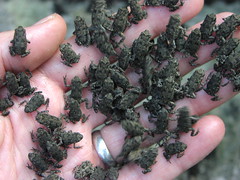
Handful of Frogs
Handful of Frogs (Photo credit: deanj)

God had Aaron use his staff to bring about a plague of frogs that would get into everything everywhere all over Egypt. Pharaoh's magicians were able to also being about frogs with their "secret arts". But Pharaoh pleaded with Moses and Aaron to beg God to take away the plague and he would let the Israelites go sacrifice to God. They talked to God about it and all of the frogs died and the land stank. Pharaoh's heart hardened and he didn't follow through on his promise.

Interesting that he's not asking for the slaves to be let free, he's still asking that they be allowed to go sacrifice to God. Also, is dead stinking frogs everywhere really better than live frogs?Perhaps he didn't keep his word because the from plague was taken away in a terrible way.

From Guzik
In His good mercy God gives Pharaoh another chance at repentance, but Pharaoh will not take it.
But not really, because as we saw before, God hardened his heart and prevented him from repenting. I think I will keep having this same disagreement with Guzik because he has tried to explain away God hardening Pharaoh's heart (which is central to this story) and I don't accept his explanation.
God threatened a plague of frogs for a specific reason. The Egyptian goddess Heqt was always pictured with the head of a frog. For this reason frogs were considered sacred and could not be killed.
Again, this is quite interesting, just as in the first plague, it seems that God is targeting the Egyptians gods more so than the actual Egyptian people. I think this really highlights the polytheistic roots of this book. If God was real, and the Egyptian gods were imaginary, why would God care that they are worshiping them? On the other hand, if the early Jews thought that multiple gods were real, then it makes sense for Yahweh to attack the other gods in their stories.

The Third Plague: Gnats (v. 16-19)
Gnats
Gnats (Photo credit: Andrew Coulter Enright)

Note: it seems that in some other versions it is lice instead of gnats.

Aaron then used his staff to turn all of the dust in the land to gnats, gnats were on everything. Pharaoh's magicians tried to replicate the trick but couldn't, and declared that this must be the work of God, but Pharaoh's heart was hardened and he refused to listen to them.

They really seem to be jumping to the conclusion that it is God really quickly. "That other guy has a magic trick that I can't do, it must be God!"

Again, from Guzik
The hardness of Pharaoh's heart is shown when he will not even heed the analysis of his own advisers. There is no rational reason why he insists on resisting the LORD God.
Why would there be a rational reason? God hardened Pharaoh's heart! Pharaoh isn't just refusing to listen to God because he's a dick, God has prevented him from doing so. 
The Egyptian priesthood was extremely scrupulous about hygiene and ritual cleansing and an infestation of lice made them unable to worship their gods. 
The plague of lice was also upon every beast. The gods of Egypt would not receive the sacrifice of lice-infested animals, so this stopped their sacrificial system.
Again, we see that the real purpose of the plagues seems to attack the Egyptian gods rather than the Egyptian people.

The Fourth Plague: Flies (v. 20-32)
English: A bug zapper
They needed a few of these (Photo credit: Wikipedia)

Then God sent swarms of flies into the land of Egypt so they would be covering everything. But he would set aside the land of Goshen where the Israelites lived so that it would be obvious that they are set apart and not being hit with the plague.

It seems like a good idea to set apart God's people from the plagues and therefore God's wrath. Why is this starting at plague 4?

Pharaoh said that Moses and his people could go sacrifice to their God as long as he took away the flies first. Moses said they needed to go 3 days away, otherwise the guards would be upset at them sacrificing to a God they don't believe in. Pharaoh said fine, so God took away the flies, but then Pharaoh changed his mind and didn't let them go worship.

Again, we have this ambiguous language about Pharaoh changing his mind. It says his heart was hardened, but the way it is written it seems as if he just changed his mind and he's an asshole. But, as we saw previously, God is the one hardening his heart. Given that we know Pharaoh's mind is being manipulated, it's pretty hard to blame him for the bad things he's doing right now.
the point of this plague was probably the same as the plague of lice. The Egyptian gods could not be worshipped amidst this uncleanness.
Again, the real purpose is to attack the Egyptian gods.

Moral of the story:
Unfortunately, this doesn't seem like it's terribly interesting yet, it is the same moral as last time as far as I can tell, worship God or else. So I guess it all boils down to obedience, Moses and Aaron are obeying God and doing horrible things to the people of Egypt, they will be rewarded. Pharaoh is not obeying God (although he's not being allowed to) and him and his people are being severely punished.
Enhanced by Zemanta

Friday, October 11, 2013

Exodus 7: Let the Plagues Begin

Today's Podcast

Previously:

God sent Moses and Aaron to Egypt to ask Pharaoh to free the slaves, armed with a few neat sounding powers. Pharaoh responded to this request by punishing the slaves harshly. Moses was discouraged and wanted to give up, but God assured Moses that his people would be freed from Egypt.

Moses and Aaron Before Pharaoh (v. 1-13)

God says he has made Moses like God to Pharaoh and Aaron is like a prophet.

I'm not sure what this means, but I have two guesses. The first is that the powers that Moses was given in chapter 4 are what makes him like a God. The problem with this thought is that Moses had those powers in chapter 5 and Pharaoh didn't look at him as a God then (although I guess Moses didn't use those powers then, what's up with that?). The only other thing I can think of is the genealogy thing in chapter 6, since that happened right before this declaration perhaps it is related. My understanding is that genealogy played a big role in their lives back then, perhaps God telling Moses his true family line is supposed to make a difference to him and also to Pharaoh. Hopefully the commentaries will weigh in on this.

Guzik says that this means God will be talking to Pharaoh through Moses. Does that sound wrong to everyone else? It could just mean that I'm completely misunderstanding what is written in the bible (wouldn't be the first time), but shouldn't being like God to someone mean you have power over them, or perhaps that they are in awe of you? Not just that you are a conduit for God to talk to them. 

Guzik goes on to say that if Pharaoh rejects Moses, that Moses shouldn't take it personally, because this will just mean that Pharaoh is rejecting God. He then makes the connection to Christians of today by saying
In the same way, God will make us "as God" to people we encounter who are rejecting God. If they harden their hearts or reject us, we shouldn't take it personally.
And there we go. Christians shouldn't take it personally if they can't convert people, they aren't rejecting you, just your God. I suppose I could put that in the morals of the story section if I didn't think Guzik was so far off base here.

Matthew Henry seems to agree with Guzik here somewhat, although he clarifies that it is not just that Moses is speaking for God, but that he has godly powers. This lines up with my first guess, and it also seems to mess up Guzik's moral of the story. Jamieson, Fausset & Brown have a similar interpretation to Matthew Henry.

God says he will tell Moses and Aaron what to say and ask Pharaoh to release his people, but God will harden Pharaoh's heart so he won't comply. Then God will multiply his signs and wonders throughout Egypt and bring his people out with great judgement.

So basically, God is going to prevent Pharaoh from releasing his people and then punish him for not releasing them. I thought God was supposed to respect free will. And how the hell is this just? It would be like holding a gun to someone's head and forcing them to commit a crime, and then punishing them for that crime.

We see the same nonsense about this from Guzik as in chapter 4
We remember that God will not harden Pharaoh's heart against Pharaoh's own desire. It is not as if Pharaoh wished to have a tender heart towards Israel but God would not allow him. God confirmed Pharaoh in his wicked inclination against Israel.
Instead, Pharaoh revealed his heart when he refused the humble request of Moses back in 5:1-4; now, God will merely strengthen Pharaoh in the evil already chose.
This just makes no sense, if it is already Pharaoh's own desire, then God wouldn't have to harden his heart, his heart would already be hardened against God's people. Guzik then quotes from the text and continues
"So that I may lay My hand on Egypt … and the Egyptians shall know that I am the LORD": This explains why the LORD hardened Pharaoh's heart - essentially, to bring righteous judgment upon Egypt: Pharaoh and the Egyptians said they didn't know who the LORD was; God is going to let them know.
Even if we give Guzik his ridiculous premise, it says that Pharaoh was coming around and God put him back on his original path, for the purpose of punishing him and his people more. Who in their right mind would classify this as "righteous"? Guzik also applies this logic to our lives
God can do the same today. In our rebellion, we may reach the place where God will strengthen us in the evil we desire
Why is this acceptable? Let's say I want to do something evil, (Oh I don't know, let's say my older brother died before he and his wife had a kid and I don't want to have sex with his wife so that he can have an heir). But then after some reflection, I realize that it would be something that God would really want me to do, but just as I am about to make the decision God "hardens my heart" against the idea and I don't wind up doing it. Then later, God punishes me for not changing my mind. Is that fair? God prevented me from doing the "right" thing here, how can he punish me? Even interpreting this in Guzik's way, the way God acted is still reprehensible.

Perhaps Wisely, the other Christian commentaries that I read didn't even address this as a problem. They just mention that God hardened Pharaoh's heart as a matter of fact.
The Rods of Moses and the Magicians Turned int...
(Photo credit: Wikipedia)

When they went to Pharaoh, Aaron proved they were with God by throwing down his staff and having it become a snake. Pharaoh then summoned his wise men and magicians and performed the same trick with secret arts. Aaron's staff/snake swallowed the rest. Pharaoh's heart was hardened and he still didn't listen to them.

The snake trick is pretty cool, what is the deal with Pharaoh having people who are able to do the same thing? I guess that Aaron's snake eating the others shows his is more powerful, but you would think God would be more original. This really just boils down to being a better version of a trick the Pharaoh has already seen.

Of course, it was Satan (again Guzik)
In the midst of an unmistakable miracle, Satan provided Pharaoh with a reason to doubt - and Pharaoh seized on the doubt and hardened his heart.
Notice what he does here with Pharaoh's hardened heart, the way Guzik writes this, it sounds like Pharaoh hardened his own heart. He must have been reading ahead to the next section.

The First Plague: Water Turned to Blood (v. 14-25)

God tells Moses that Pharaoh's heart is hardened, and he refuses to let the slaves go free.

I noticed a bit of a change of tone here, previously God kept talking about how He was going to harden Pharaoh's heart, but now he's just saying that his heart is hardened. Compare these older verses:
  • v3: I will harden Pharaoh's heart
  • ch4 v21: I will harden his heart, so that he will not let the people go
to these verses
  • v13: Still Pharaoh's heart was hardened, and he would not listen to them
  • v14: the LORD said to Moses, "Pharaoh's heart is hardened; he refuses to let the people go
It's like God goes from "I will keep him from releasing your people" to "Hey look, Pharaoh's being a dick and not letting your people go". 
Aaron changes the water of the Nile into blood
Aaron changes the water of the Nile into blood (Photo credit: Wikipedia)

God had Moses turn the water in the Nile (as well as all water in canals, ponds and pools of water) into blood in the sight of Pharaoh. All of the fish in the river died, and the Nile stank, so the Egyptians couldn't drink the water. They had to dig along side the Nile to find water to drink instead. But Pharaoh's magicians were able to do the same trick so Pharaoh's heart was still hardened.

Where shall I start? I suppose I'll ask why it was necessary for God to ruin all of the other water in the place. Doesn't turning the Nile into blood prove your point? Why ruin water that people had collected the day before? 

Won't tons of people die here? Not only did they lose their water supply, but if all of the fish died I imagine a lot of people lost their food source as well, not to mention the fishermen's livelihoods. 

Pharaoh's magicians could do the same trick? Who the hell are these guys, and why did God do generic tricks that any random magician can do? Also, how did they do the same trick? Moses turned all of the water in Egypt to blood, then the magicians also turned the water to blood? But all of the water is already blood, so that makes no sense. Are we to believe that the magicians had done this previously? Why the hell would they want to do that?

And finally, verse 22 says that Pharaoh's heart was hardened because his magicians could do the same trick, not because God hardened it. So which is it?

A few interesting things from Guzik here
God did not plague Egypt because Pharaoh would not let the children of Israel go; but because Pharaoh refused to recognize and honor God
Why do Christians find this kind of reasoning acceptable? Bring it down a few levels, suppose we have a father who has a couple of kids who are getting beat up in school. What if he was upset at the bullies because he felt disrespected instead of the simple fact that his children are being attacked? What would you think of that father? He's a piece of shit right? But for some reason it's acceptable when it is God.
Specifically, this first plague was directed against the numerous Egyptian river deities. The Nile itself was virtually worshipped as a god by the Egyptians, and the LORD God shows that He has complete power over the Nile, not some river god.
Now that is actually really interesting.

Moral of the Story

Apparently the moral of this story is recognize and honor God or you could face God's wrath. Essentially worship God or else. I'm sure it will come as a surprise to no one that I find this completely unacceptable.

For the Verses of Note post:

--Free Will--

Exodus 7:2-4 God hardens Pharaoh's heart to prevent him from following God's command

"..you, and your brother Aaron shall tell Pharaoh to let the people of Israel go out of his land. But I will harden Pharaoh's heart, and though I multiply my signs and wonders in the land of Egypt, Pharaoh will not listen to you..."

--Justice--

Exodus 7:3-4 God punishes the Egyptians because God prevent Pharaoh from listening to him

"But I will harden Pharaoh's heart...Pharaoh will not listen to you. Then I will lay my hand on Egypt and bring my hosts, my people the children of Israel, out of the land of Egypt by great acts of judgment."

--Magic--

Exodus 7:10-11 Aaron and Pharaoh's men all turned their staves into snakes

"Aaron cast down his staff before Pharaoh and his servants, and it became a serpent. Then Pharaoh summoned the wise men and the sorcerers, and they, the magicians of Egypt, also did the same by their secret arts."

Exodus 7:20,22 Moses turned all of the water in Egypt into blood, as did Pharaoh's men

"Moses and Aaron did as the LORD commanded. In the sight of Pharaoh and in the sight of his servants he lifted up the staff and struck the water in the Nile, and all the water in the Nile turned into blood....But the magicians of Egypt did the same by their secret arts."
Enhanced by Zemanta
Related Posts Plugin for WordPress, Blogger...